Ol Montana's best!

Do you know what your party stands for?
Education is key in elections!
POLITICS, NOT POLITICS
Jayson Olthoff
4/18/20263 min read
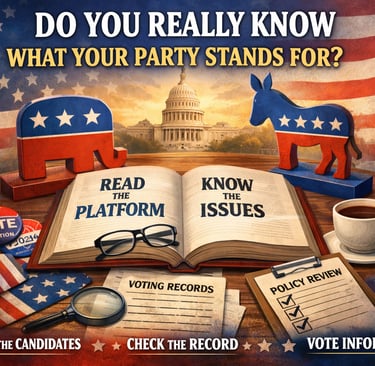
Do You Really Know What Your Party Stands For?
One of the biggest problems in modern politics is not always corruption, division, or even bad policy. Sometimes, the biggest problem is something much simpler:
Many voters do not actually know what their own party stands for.
During a recent conversation, we discussed how many people proudly identify as Republican or Democrat, yet have never taken the time to read their party platform. They may support candidates, share posts online, and vote every election cycle—but when asked what their party officially believes, many cannot clearly answer.
That should concern all of us.
What Is a Party Platform?
A political platform is the foundation of a party’s values and priorities. It outlines what that party believes regarding taxes, government size, education, property rights, public safety, social programs, energy, and more.
Think of it as the blueprint.
Candidates often run under a party label, but the real question voters should ask is:
Do their actions actually match the platform they claim to represent?
That question matters.
The Montana Republican Platform: Common Sense Principles
In our discussion, we reviewed several core principles often associated with the Montana Republican platform. While the full document is more detailed, many of the ideas can be summarized in practical terms:
Lower taxes and simpler tax policy
Smaller, more accountable government
Protection of private property rights
School choice and parental involvement
Respect for life and family values
Responsible use of natural resources
States’ rights and local control
Rule of law and constitutional government
Helping people with a hand up, not a handout
Government accountability to taxpayers
When most people hear those ideas, they often say, “Yes, that sounds right.”
Which raises an important point:
Many voters may already believe in these principles—they just have never connected them to the official platform.
Personality vs Performance
Another topic we covered was how often voters choose candidates based on familiarity rather than results.
We hear things like:
“I’ve known them for 30 years.”
“They’re a nice person.”
“Their family has always been involved.”
“I voted for them before.”
Those things may be nice—but they are not qualifications.
Being likable does not automatically make someone effective. Name recognition is not a policy position. Friendship is not leadership.
Voters should be asking:
Did this person keep their promises?
Do their votes align with what they claim to believe?
Have they produced results?
Are they representing the taxpayer?
That is how accountability works.
Why Records Matter
One of the most powerful points from the conversation was simple:
Look at voting records, not campaign slogans.
Campaign season is full of polished messaging, smiling photos, and promises. But once someone has served in office, their record becomes the clearest picture of what they truly stand for.
Votes reveal priorities.
If someone campaigns as conservative but repeatedly votes for bigger government, more spending, or policies opposite their stated values, voters deserve to know that.
The Taxpayer Needs a Voice
Many organizations advocate for specific interests—business groups, unions, industries, nonprofits, and causes.
But who is advocating for the everyday taxpayer?
The worker paying bills.
The family paying property taxes.
The small business owner trying to stay afloat.
The citizen funding every layer of government.
That perspective is often forgotten.
Politics should not only serve organized interests. It should also protect the people carrying the financial load.
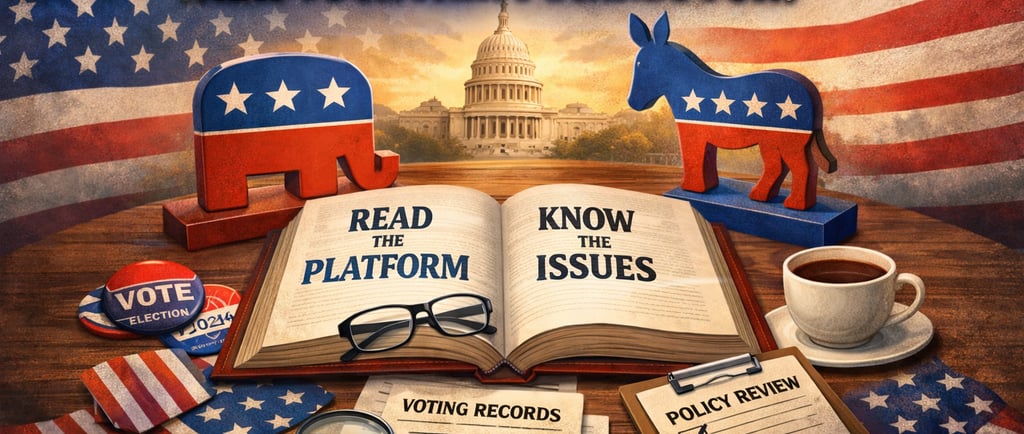
Read Before You Vote
Whether you are Republican, Democrat, Independent, or undecided, this challenge applies to everyone:
Read the platform.
Study the candidates.
Check the record.
Vote informed.
Don’t vote based solely on signs, slogans, personality, or history.
Vote based on principles, performance, and integrity.
Final Thought
Democracy works best when citizens are informed and engaged. If voters know what they stand for—and hold leaders accountable to it—government becomes stronger, more honest, and more responsive.
That starts with one simple question:
Do you really know what your party stands for?
Location
info@olmontana.com
(406) 899-0404
Great Falls Montana 59405
Connect
Read Digital Edition
Partner With Us
© 2026 Ol Montana